Inductive loops cut into the road surface have been the standard traffic detector for decades. Many road operators therefore ask whether loops can also detect stopped vehicles, or whether video detection from traffic cameras is the better choice. This page compares both technologies for this specific task.
How Inductive Loop Traffic Detectors Work
An induction loop is a coil of wire installed in a saw cut in the asphalt and connected to a loop detector in a roadside cabinet. When a vehicle with a metal body passes over the loop, the inductance of the coil changes and the detector registers the vehicle. Traffic detection loops are reliable for counting vehicles, measuring occupancy and estimating speed at the point where they are installed.
Why Loops Struggle to Detect Stopped Vehicles
- They only see their own spot: a loop detects a vehicle only directly above it. Loops are usually installed at intervals along the road, so a vehicle that stops between two loop stations is not detected directly.
- Indirect detection only: loop-based incident detection usually infers an incident from changes in speed or occupancy further upstream. In light traffic such changes may not appear at all.
- Hard shoulder and lay-bys: loops are normally installed in running lanes, so a vehicle stopped on the hard shoulder is typically outside their reach.
- Installation and maintenance in the road: installing or repairing a loop means cutting the road surface and closing lanes, and loops are often damaged during resurfacing.
Video Detection from Existing Traffic Cameras
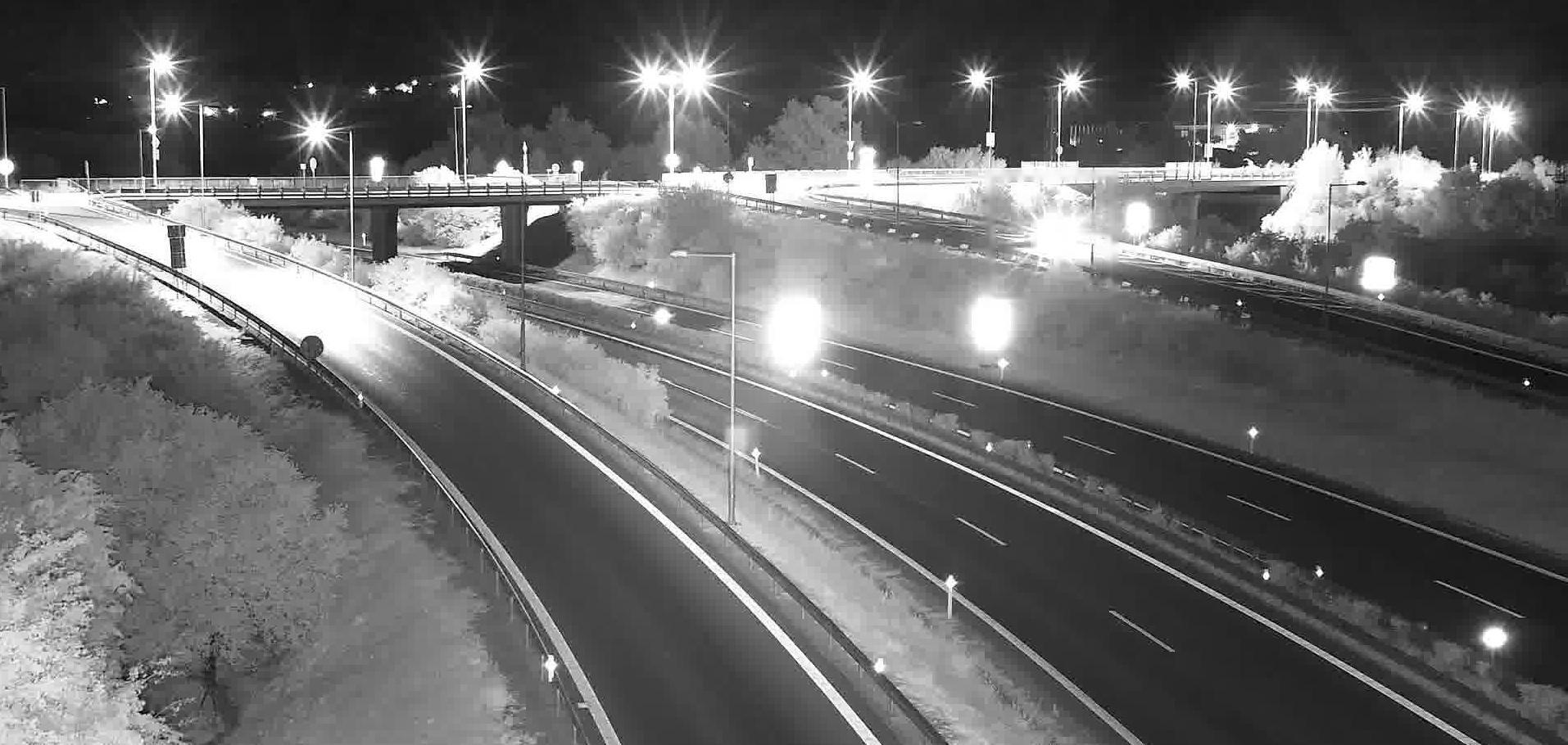
Video vehicle detection analyses the image from a traffic camera, so it covers the whole area the camera sees – all lanes, the hard shoulder and the lay-bys – not just a single point. Our software uses artificial intelligence to recognise vehicles that stop where they should not and alerts the operator, who can verify the situation directly in the camera image.
Because it works with the existing IP or analog (CCTV) cameras, there is no work in the road surface and no lane closure for installation. Learn more on the How it works page.
Comparison: Inductive Loops vs. Video Detection
| Inductive loops | Video detection (our software) | |
|---|---|---|
| Detection area | The spot above the loop | The whole camera view |
| Stopped vehicle between detectors | Only indirectly, from traffic changes | Detected directly in the image |
| Hard shoulder and lay-bys | Usually not covered | Covered if in the camera view; zones can be masked |
| Verification by operator | Not possible from the loop data | Operator sees the camera image |
| Installation | Saw cuts in the road, lane closures | Access to the existing video stream |
| Counting and speed statistics | Well proven | Data on frequency and duration of stops |
Loops and Video Work Best Together
Video detection does not have to replace your loops. Loops remain a good source of traffic counts and speed data, while video detection adds what loops cannot provide: direct detection of a stopped vehicle anywhere in the camera view. Our software can be integrated with your traffic control centre alongside existing detectors as part of your automatic incident detection.
Our stopped vehicle detection is in operation on expressways in Slovakia and the Czech Republic. Contact us to discuss your road sections.