Slide 3
Smart Traffic Monitoring for Safer Roads

Advanced traffic monitoring for car stop detections

84,885

SUCCESSFUL DETECTIONS

26

CAMERAS

Slide 3
Smart Traffic Monitoring for Safer Roads

Advanced traffic monitoring for car stop detections

84,885

SUCCESSFUL DETECTIONS

26

CAMERAS

Slide 3
Smart Traffic Monitoring for Safer Roads

Advanced traffic monitoring for car stop detections

84,885

SUCCESSFUL DETECTIONS

26

CAMERAS

Enhancing Road Safety with Advanced Stopped Vehicle Detection

Welcome to our comprehensive gallery showcasing the critical technology behind Stopped Vehicle Detection (SVD). On today’s highways and urban roads, every second counts. The accurate and immediate detection of a stopped vehicle is paramount, whether it’s a minor breakdown or a major road hazard.

Our visuals provide an in-depth look at how various challenges—from low visibility and distance to complex environmental occlusions (like a road sign or heavy traffic)—affect the reliability of modern detection methods.

Why Accurate Vehicle Detection Matters

  • Hazard Mitigation: Quick identification of a stopped vehicle dramatically reduces the risk of secondary collisions and traffic bottlenecks.
  • Precision in Action: We highlight the ability to confirm a vehicle is truly stopped, minimizing false alarms and ensuring operator focus remains on verified incidents.
  • Diverse Scenarios: Explore how detection is maintained even when a vehicle is partially obscured, severely distant, or blends into the background, including the challenging detection of large trucks.

The gallery serves as a powerful resource demonstrating the precision needed for modern traffic monitoring. Trust in systems that deliver reliable detection when it matters most, ensuring smoother and safer travel for everyone.

Explore the future of traffic safety through precise stopped vehicle detection.

Extremely difficult detection of a stopped vehicle that is almost entirely hidden behind a large road sign.
This visual captures a critical example of severe occlusion, where a substantial road sign almost completely hides a stopped vehicle. The lack of visible features makes reliable detection exceptionally challenging, as only the smallest parts of the vehicle are discernible, creating a significant potential hazard.
Clear detection bounding box highlighting a large stopped truck (heavy vehicle).
This visual shows the clear detection of a large stopped truck. Due to their size and mass, the accurate detection and monitoring of vehicles of this type are vital for overall traffic flow management and safety on major roads.
Orientation: 1
Clear visual of a large stopped truck, requiring specialized processing for effective detection and classification.
This image serves as an example for the specialized detection required for heavy goods vehicles. Unlike smaller cars, the stopped truck's complex structure, high cab, and trailer require robust algorithms to accurately classify its boundaries and state. This is vital for traffic management and automated driving safety around large commercial vehicles.
Orientation: 1
Clear detection bounding box confirming a stopped vehicle in the image frame.
This visual clearly highlights the perimeter of the stopped vehicle. Accurate detection of vehicle state is crucial, as the confirmed presence of a stationary object informs operators about potential blockages or hazards within the traffic environment.
Orientation: 1
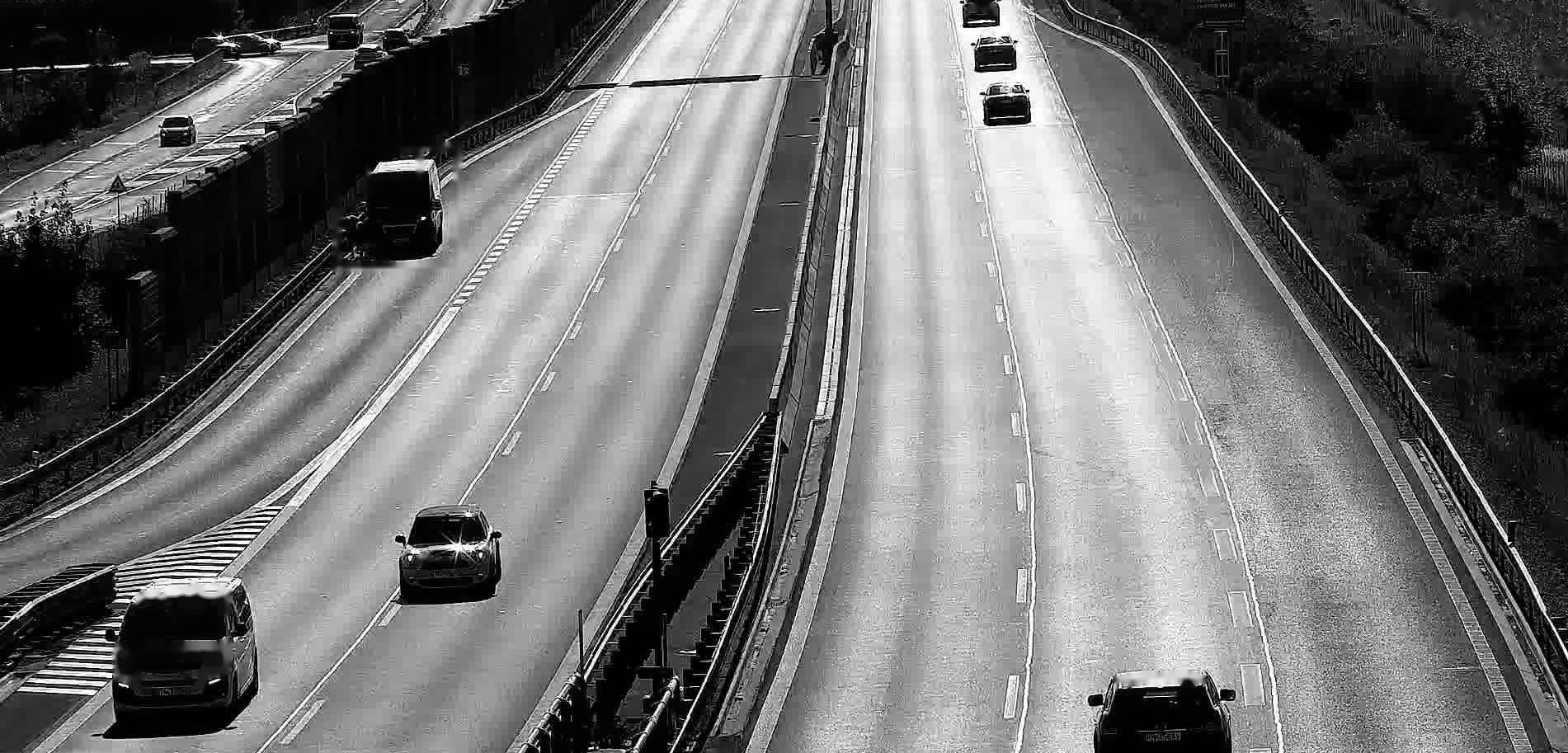
Selective detection view showing only specific stopped vehicles highlighted for the operator within a dense line of traffic.
This visual demonstrates an efficient use of detection resources where the system selectively tracks essential indicators—specifically, the status of stopped vehicles within a traffic jam or queue. By focusing on a subset of vehicles, the system minimizes processing load while ensuring the operator is immediately notified of the overall traffic flow and any critical stopped obstructions.
Orientation: 1
Difficult detection of a stopped vehicle due to obstruction by a large road sign.
This challenging visual illustrates how a large road sign can create a critical occlusion, completely blocking the line of sight to a stopped vehicle. This scenario demands robust detection and prediction algorithms, as the hidden vehicle poses a clear hazard that cannot be directly observed until the last moment.
Orientation: 1
Detection of the stopped vehicle is nearly impossible for the human operator due to severe visual constraints.
This visual emphasizes the disparity between machine and human perception. The conditions shown make the stopped vehicle almost imperceptible to the naked eye, underscoring why automated detection is critical. This scene presents a failure point in human monitoring, where reliance must shift entirely to advanced sensor systems to confirm the vehicle's presence.
Orientation: 1
Detection challenge: The view of a stopped vehicle is blocked by a structural column, causing severe occlusion.
This image provides a clear test case for object occlusion. A structural column blocks a significant part of the stopped vehicle's profile, forcing detection systems to rely on partial visibility or predictive modeling to confirm the vehicle's presence and type. This scenario is common in urban environments and parking structures, demanding highly advanced detection capabilities.
Orientation: 1
Stopped vehicle is nearly invisible against road lines, posing a difficult detection problem.
This image vividly illustrates the difficulty in detection when a stopped vehicle is poorly contrasted against road markings. The camouflage effect significantly reduces the time available for drivers to notice the stationary object, making its presence a critical safety issue.
Orientation: 1
Difficult detection of a stopped truck due to a large road sign completely obscuring the vehicle.
This visual highlights a challenging occlusion scenario where a large road sign severely blocks the line of sight to a stopped truck. The limited visible portions of the vehicle make precise detection and classification extremely difficult, impacting overall road safety and the reliability of advanced driver assistance systems.
Orientation: 1
Highly challenging visual for detection of a small, distant stopped vehicle due to low resolution.
This image serves as a benchmark for long-range object detection systems. Due to the substantial distance, the stopped vehicle appears small and pixelated, leading to low confidence scores and potential classification errors. This scenario is crucial for testing the limits of imaging and sensor technology used in autonomous vehicle operations.
Orientation: 1
We apologize for the reduced quality of some images on this website. All photos were captured from cameras in real traffic environments and are published with the consent of the respective road authority.

To date, our software has made 84,885 successful detections on 26 cameras.

Back to Top